Thursday January 10 at 7PM. Lincoln Theatre, Damariscotta, Maine
TALKING ART IN MAINE with host Jane Dahmen and her guest, gallery artist, SAM CADY.
Thursday January 10 at 7PM. Lincoln Theatre, Damariscotta, Maine
TALKING ART IN MAINE with host Jane Dahmen and her guest, gallery artist, SAM CADY.
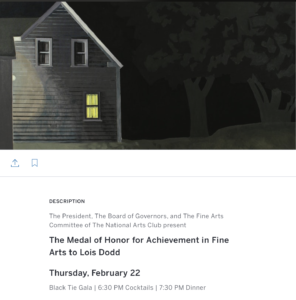
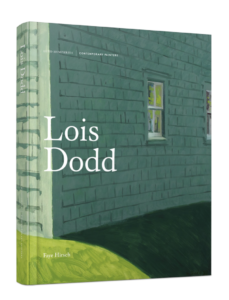
LOIS DODD: Selected Paintings, ALEXANDRE GALLERY, NY, NY. December 2, 2017 through January 27, 2018 – in conjunction with the publication of “Lois Dodd”, a monograph by Faye Hirsch.
Lund Humphries Contemporary Painter Series
Hardback, 144 pages, 100 color illustrations. Publication: October 6, 2017
Daniel Gauss, writing in Wall Street International, has posted a review of new work by Alan Bray – INWARD MAINE, at Simon/Garvey Gallery in New York.
http://wsimag.com/art/32572-inward-maine
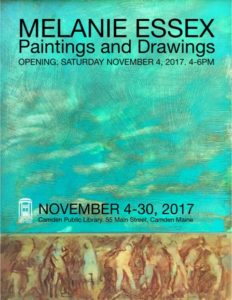
The Camden Public Library welcomes Melanie Essex to the Picker Room Gallery for the month of November. Her dynamic and colorful paintings hold fascinating hidden detail. There will be an opening reception on Saturday, November 4 at 4:00 pm, with a chance to meet the artist.
“All of my work begins with looking at, then responding to the natural world,” says Essex. “As a young painter in New York, I worked in a life studio, drawing and painting from the model 8 hours a day, 5 days a week for 4 years. In the summers I would get out of the city, when I could, to work directly from the rural, waterfront landscape of my childhood on eastern Long Island. Painting in that low, bucolic bay setting had a huge impact on the way I developed as an artist. There were big skies over thin strips of land, barrier beaches or the distant shore across the bay. I often worked on wood panels, joining them together horizontally to span a vista, or vertically to emphasize events along the horizon. I decided I was a landscape painter and that was that.”
A move to London in 1995 shifted her focus to urban landscapes – first exploring the view from her World’s End studio, then painting for several years from perches at the top of skyscrapers and finally from the banks of the Thames.
Though humans rarely appeared in this work, she kept drawing from the figure throughout. At first, Essex drew from paintings in the National Gallery. Titian, Tintoretto and Veronese were her favorites. Going forward, she snatched opportunities where she could – taking a life class at the Royal College of Art, sharing a model with painter friends, joining groups in London and then in Rockland as well in Tenants Harbor and Thomaston. Those summer sessions were especially wonderful as they drew outside – amongst trees, unruly vegetable gardens, stacks of firewood, sleeping dogs, curious chickens – in the landscape.
“Then,” Essex continues, “About ten years ago figures began creeping into my work to compete for attention with the sky and the ground. The Field/Sky/Figure series was made in my last London studio – a converted greenhouse at the bottom of an overgrown garden. The Thames was in walking distance and supplied plenty of material – sky, clouds, tidal water, fog and the kind of dramatic sunsets enhanced by urban pollution. Increasingly figures began to dominate the painted fields beneath the skies. The Power Plant series evolved as a counterpoint – signaling the human presence in the form of silos, typical of post-war power generating stations in the UK.”
Melanie Essex graduated from Harvard in 1981 and after a successful career in film production – her work is now part of the permanent collection of the Museum of Modern Art – she studied painting at the New York Studio School from 1990-1994. Her work has been exhibited in London and New York and in Maine, and is in important private collections on both sides of the Atlantic, including several trustees of the Metropolitan Museum of Art in New York. After two decades in London she has returned to the US and lives and works in Cushing, Maine. She is represented by the Caldbeck Gallery in Rockland Maine.
Camden Public Library
55 Main St.
Camden, Maine 04843
K. MIN
from here to there
McCoy Gallery, Rogers Center for the Arts, Merrimac College, North Andover, MA, October 26 – December 22, 2017
“I draw anything that comes to my attention visually, emotionally, and psychologically.”
K. Min’s small paintings and pastels of insects assert an unblinking affection for her subjects by memorializing them as specimens of the real world. Contained, fragile and nearly weightless, the insects as described by Min are presented as markers of their own existence. Similar in their delicate thinness to the insects, the elevated grain hoppers of Texas #1 and Texas #2 are determined by their mechanical purpose. Their landscape settings are flat and nearly neutral fields of spatial ideas. These objects, insects and grain hoppers among others in this exhibition, are only as much as they need to be, minimal without being minimalist. They occupy our attention by igniting our sense of their function and their curiousness.
Time is slowed down as images glide into the space of our vision the way clouds do. Our seeing works selectively to collect bits of now, of then and of later on. In her series of stained upholstered chairs and couches, Min was motivated by an accidental occurrence. She had completed a couch painting, photographed it and then printed the image. The print was damaged by a drop of water, diluting and altering the color of a small part of the image making the couch appear stained. Drawn to this alteration, Min went on to continue the couch and chair project by incorporating more ‘stains’, suggesting forensic narratives and crime scenes. However interpreted, these images challenge our aesthetic norms. The stains that may repel us also intrigue and compel us to remain tuned to their dissonance. Leaking #2 demonstrates Min’s steadiness of purpose, its pale violet chair appears assaulted by age, its domestic comfort slipping away from a history of too much experience. Related to the stained couches and chairs are the bread and sweets with and without mold. Decay becomes an insistent presence. Things change and become other things. Things die. Even in the presence of such morbidity, experiencing these images also yields an unexpected and quiet humor. The large couch of the ironically titled Therapy is like a decorative infection.
Min’s subjects are not all bruised or wounded, but many are marked by elements that isolate the subjects in space and time. The small pastel landscape Spring Fire is a haunting scene that layers a dark foreground against a dimmed background. Between the division of land and sky, smoke rises from a sliver of fire indicating wind direction as it specifies an event left unexplained. This incident is seen from the road—a landscape story. Another road painting, Hope for Mt. Agamenticus, directs our attention through a dense alley of dark trees under a paler sky to a small bright green patch of light. Road imagery implies a sense of change, in this case a change unnamed. This condition of mutability is developed in Min’s painting and drawing process. The edges of things are frequently blurred, a softening effect called sfumato in Italian painting. In Min’s work this method gently shakes forms, creating a peculiar, soft vibration.
In Morning Tub, Min places the tub in a boxed-in space, quietly asserting architectural pragmatism. Min’s immobile subjects lend themselves to being contained and, like the insect images, preserved as collected inventories of experience.
Min’s paintings and drawings are deliberations on memory. When I first saw After the Rain, it felt vividly familiar. Was it the trisected space of sky, trees and pavement? The dull, grayness of the overall picture? Or was it the solitariness of the white propane tank—the central form—bright against its darker surroundings? Such ordinary objects, secured in a metal fence, like a framed icon—the space seemed to become my own memory as if my seeing it reinforced its existence. Min’s images pulsate like reenactments of thought. The utility pole in the drawing On the Way to the Post Office establishes an anchoring effect against the thick tangle of the trees. The moment is one of conditions rather than events. The smear of coral pink light on the wall over the bed in New York Story (Sunset) seals the image within the rhythmic alterations of time.
Light is frequently more than illumination; in some paintings light is a figure itself. The electric lights in Working Time are set against the dark, enabling their own visibility as devices. Off Hours and Foggy Night make light as much of a subject as that which is lit. Night imagery is also explored in Min’s pastel Billboard, whose darkness frames the surface of the greenish blue billboard surface.
Untitled Round Table presents the glowing fantasy of a covered table floating in a utopian space designed only to contain one thing. This image evokes the quiet dreaming of the Belgian surrealist, Rene Magritte, whose subjects frequently deny gravity. The table cloth reveals only the table’s contour, recalling Magritte’s shrouding of figures, the unseen subjects falling prey to an anxious victory of unknowing. Where light exposes objects and spaces to our seeing experience, darkness alerts us to what we do not experience. Despair draws a black shade down a window, blocking an unseen view. The covered window enables a locked-in, protected intimacy at the cost of a thwarted connection with what is out of sight. Despair is antithetical to much of Min’s work, but serves as a sensory balance, recognizing the partnership of light and dark.
The small First Tree and the large, multi-paper Winter Tree describe the unrushed vitality of living nature, the branches of the trees leading the eye upward, while dividing the space they occupy. Nearly abstract compositions, the trees have the feel of cropped anatomical studies, their organic reach carrying the eye beyond the fictive space they inhabit. The trees suggest an arcing and muscular choreography encouraging a sense of our relatedness to them. Min’s paintings, pastels and drawings manifest a plainspoken idealism at the heart of representation—a persuasive urging to see beyond naming what we see.
-David Raymond
|
|||||||||||||||||||||
 |
|||||||||||||||||||||
|
|||||||||||||||||||||
|
|||||||||||||||||||||

http://www.phopagallery.com/current-exhibition/
Todd Watts’ solo exhibition, Blanchard Weather Report features 40 photographs that explore our relationship with art and the world we live in.
Todd Watts writes: “The Blanchard Weather Report began in 2014 as a conversation about art and the earth, carried out in pictures over the Internet with friends and colleges around the world. The exhibition are the pictures from that conversation. The images themselves are a combination of lessons from art history with reflections on climate change.”
Todd Watts graduated from the sculpture department at the School of Visual Arts in New York in 1971. From 1972 to 1979 he taught photography at his alma mater and at Hunter College. In 1973, he founded an architectural photography company. His clients included Phillip Johnson, I.M. Pei, Richard Polshek, and he was commissioned by Minoru Yamasaki to photograph the construction of the World Trade Center in its final stages. In 1974, he was commissioned by New York’s Lee Witkin Gallery to print Berenice Abbott’s first portfolio. Subsequently, he produced seven more Abbott portfolios in his New York studio. In 1974, he bought a house in Blanchard, Maine; and he, with Jemma Gascoine, moved permanently to Maine in 2000.
Watts’s work—with his exploration of the changing environment, genetics, and resulting cultural ramifications—has been exhibited and collected internationally, including “New Lamps for Old,” at the Grey Gallery in New York, and “Passenger Pigeon,” at the The Museum of Photography in Chicago. Recent Maine exhibitions of his work include: “String too Short to Use,” at the University of Maine Museum of Art in Bangor, and the “Honors Show,” at the Center for Maine Contemporary Art (CMCA). His work is represented in Maine by the Caldbeck Gallery in Rockland.
Art New England March April 2017
Mark Wethli: Piper Cub; Sam Cady: Parts of the Whole
Center for Maine Contemporary Art • Rockland, ME • cmcanow.org • Through May 14, 2017 and May 21, 2017
By: Carl Little
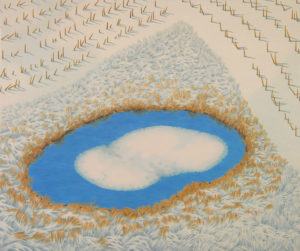
Sam Cady, skylight with blue shadow, 1979, oil on shaped canvas, 22 x 48″.
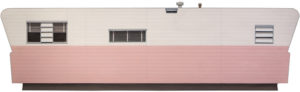
The painter Sam Cady is renowned for his shaped canvases in which, to borrow from the title of this retrospective, parts of the whole are presented, often with trompe-l’oeil precision. The 34 pieces in this show, produced between 1970 and 2016, offer a wide-ranging selection of Cady’s cut-outs, from a construction trailer on Canal Street in New York City to a section of the Knife Edge trail atop Mount Katahdin in northern Maine.
Born in Boothbay Harbor in 1943 and a longtime resident of Friendship in the midcoast, Cady has taken a special interest in coastal motifs. Islands are among his favorite subjects, especially Sand and Little Sand, which lie between Hatchet Cove and Muscongus Bay. He presents them in profile or from a gull’s-eye angle, their edges cut to incorporate spruce trees and their reflections. The illusion is astonishing.
The show also features a group of Cady’s urban images. As a teacher in the MFA program at the School of Visual Arts in New York City for 25 years, he had the opportunity to study and render the Big Apple in what might be called a synecdochical manner. Two urban towers, midtown Manhattan, 1998, is a dramatic skyward view of shimmering buildings cutting into the sky like a trapezoidal wedge of glass.
Skylight with blue shadow and stairwell roof house, N.Y.C., both from 1979, bring to mind some of Lois Dodd’s city scenes. Like Dodd, Cady is a tonalist when it comes to color, for the most part preferring a quiet palette. Form, space and chiaroscuro guide his aesthetic.
Occasionally Cady will focus on a single object. F Admiration with center button (husband), 1974, a self-standing reproduction of a green upholstered pillow, recalls some of the witty frescos of his contemporary Barbara Sullivan. In several pieces he captures the svelte lines of boats: a dory tipped up on its keel, a single scull that Eakins would have admired for its precision contours.
The exhibition includes a few traditional rectangular paintings, including a New Mexico landscape and a view of a storm at dusk as seen from an airplane window. While appealing, the pieces, through no fault of their own, lack the edgy dynamic of their neighbors. An exception is loading up on the Mississippi at New Orleans, 2015, a small rendering of industrial dock activity worthy of Charles Sheeler.
One of Cady’s earliest pieces in the show, balsa model plane under construction, fuselage, 1974, makes a nice segue to Mark Wethli’s near-concurrent installation, Piper Cub, a full-scale replica of a Piper J-3 aircraft made from pine, birch plywood and aircraft parts. The plane, which was previously displayed at the Coleman Burke Gallery in Brunswick, ME, in 2007, was reassembled for this showing.
Mark Wethli, Piper Cub, 2007, pine, birch
plywood, and aircraft parts, 35 x 22 x 7′. Private collection.
Oldenburgian but without the humor, Piper Cub is a hybrid: an outsize model airplane doubling as a sculpture. The aircraft is mostly seethrough; its warm, yellow wood wings, struts, engine and propeller set on black rubber wheels. The piece has personal significance: Wethli’s pilot father restored a Piper Cub by hand when the artist was a young boy; he also helped his son fabricate the one on view.
Since moving to Rockland in July, the Center for Maine Contemporary Art has returned to offering exhibitions year-round (it had shifted to a seasonal schedule at its former quarters in Rockport in 2009). The new CMCA space provides more room and bigger walls, making it the ideal venue to present the Cady and Wethli works.

Alan Bray WET SPOT (fragment) 2016 casein on panel 18 x 24 inches |
| Talking Art in Maine, Intimate Conversations: Alan Bray
Talking Art in Maine is a series of intimate, one on one conversations between artist, Jane Dahmen, and notable artists and curators who have made a substantial contribution to the arts in the state of Maine. They are offered free to the public. Alan Bray‘s meticulous casein paintings are visions “as fine, clear eyed and imaginative as any art of Maine has ever been.” Edgar Allen Beem About our host, Jane Dahmen. Jane is a contemporary realist artist whose recent landscapes explore the forests and coastal regions of mid coast Maine. Free and open to the public.
Presented in partnership with:
Art Collector Maine H M Payson
Maine Home + Design
|
Show Dates + Times
Thu, Mar 23 @ 7 pm
|
Lincoln Theater, Damariscotta, Maine
2 Theater St, Damariscotta, Maine (207) 563-3424 info@atthelincoln.org

Talking Art in Maine, Intimate Conversations: Alan BrayTalking Art in Maine is a series of intimate, one on one conversations between artist, Jane Dahmen, and notable artists and curators who have made a substantial contribution to the arts in the state of Maine. They are offered free to the public. Alan Bray‘s meticulous casein paintings are visions “as fine, clear eyed and imaginative as any art of Maine has ever been.” Edgar Allen Beem About our host, Jane Dahmen. Jane is a contemporary realist artist whose recent landscapes explore the forests and coastal regions of mid coast Maine. Free and open to the public. Presented in partnership with:
|
Show Dates + Times
Thu, Mar 23 @ 7 pm
|
Review by Tatiana Istomina
May 23rd, 2014
Alan Bray could be a character in a Henry James novel: a New Englander who traveled to Europe and found himself profoundly changed by the experience. Born in Waterville, Maine, in 1946, he grew up in Monson, Massachusetts, studied at the Art Institute of Boston and the University of Southern Maine, and in 1971 went to Florence to enroll in a Masters program at Villa Schifanoia Graduate School of Fine Arts. According to the press release of the show now on view at Garvey Simon Art Access, Florence presented Bray with three treasures: a new painting medium (casein tempera), the examples of the Italian masters (Fra Angelico, Pietro Lorenzetti and Simone Martini), and a renewed and growing attachment to his native New England.
Wystan Hugh Auden referred to Henry James as the “Master of nuance and scruple”. The phrase appears to be an apt description of Bray: his small-scale landscapes at Garvey Simon suggest a highly sensitive, delicate and conscientious artistic disposition. The landscapes are the tranquil views of inland Maine: a footbridge over a small creek in the snow-covered woods, a field criss-crossed by diverging paths, a cloud sitting on the top of a hill. The paintings are made with casein on panel, and when viewed at a close range, their dry surfaces display intricate networks of closely-knit brush strokes. The depicted landscapes are highly simplified: all accidental details eliminated, all shapes reduced to their closest geometric analogs, organic chaos organized into geometric pattern. The apparent simplicity of the images, combined with the traditional subject matter and the unabashedly pleasing colors would have brought these works dangerously close to illustration – if not for the sophistication of Bray’s technique. The intense, slightly bizarre effect produced by these works is partly due to the dissonance between the ostensible prettiness of the images and the the formal austerity, even harshness of the method of painting used to create them.
The best of the paintings on view are posed exactly in the midpoint between the figurative and the abstract: the regular shapes that look like Plato’s ideas of trees, logs and ponds are organized with the precision of a mathematical proposition, while a few details supplied by the artist’s sharp observation of nature link these shapes to the reality of the tangible world. Such perfect balance is very hard to achieve: a work that strays too far into the world of ideas tends to turn into an abstract pattern. On the other hand, if it moves an extra step into the opposite direction, it runs the risk of becoming an inert and somewhat mannered landscape. The best piece in the show, “Winter’s false start,” finds an exact equilibrium between the observed reality and the mental diagram. The effect is striking and slightly disorienting: like the duck-rabbit figure, the image is perceptually ambiguous, oscillating between a pond in a field covered with snow and an abstract composition in white, blue and yellow.
This is also the piece that makes the viewer stop and ask herself – what could be the meaning of this work? The visceral pleasure produced by the painting is baffling and demands explanations. Surely, a serious art practice, especially one that has been sustained for over four decades, is an expression of a vision, of the artist’s understanding of the world – but somehow it has become rather difficult today to think of landscape painting as a vehicle of meaning. Bray’s works are going against the grain of contemporary painting and perhaps even contemporary sensibility – but they have a strong quiet presence, which indicates that something important is being said. What it is exactly, is hard to put in words. Perhaps they suggest that there is some kind of innate order in the organic chaos of life, a deeply ingrained law of clarity and perfection. Finding a rational order at the heart of reality might have been a difficult task for Italian Renaissance painters, but for an artist working today it is an almost impossible feat. Moreover, this is the task that cannot be achieved once and for all: with every new scene and every new painting the artist needs to start over again – but when his search is successful, life has a bit more order in it.
From 2012, here is Stephen Knudsen’s review of Lois Dodd’s traveling retrospective Catching the Light. Knudsen highlights the breadth of the retrospective, and touches on themes that arise throughout her extensive and influential body of work.
John Yau, writing in Hyperallergic, has posted a review of new work by Lois Dodd.
“About William Carlos Williams’s most anthologized poem, “The Red Wheelbarrow,” Robert Penn Warren and Cleanth Brooks said in their book, Understanding Poetry:
[…] reading this poem is like peering at an ordinary object through a pin prick in a piece of cardboard. The fact that the tiny hole arbitrarily frames the object endows it with an exciting freshness that seems to hover on the verge of revelation.
Had Warren and Brooks known of Lois Dodd’s paintings, I imagine they would have arrived at a similar conclusion, though I am inclined to think they would have revised the phrase, “arbitrarily frames the object.” That’s because there is nothing arbitrary about the way Dodd discovers her subject — the fusion of viewpoint and familiar object — in the routines of her everyday life. By framing these objects — a window, a clothesline, a cherry tree — in changing seasons and times of day, she finds ways to see her life anew, to celebrate the commonplace, while astutely probing the pressures modernism has placed on the picture plane.”
Camden artist Maggie Foskett dead at 95
Pioneered creative photographic technique called cliché verre
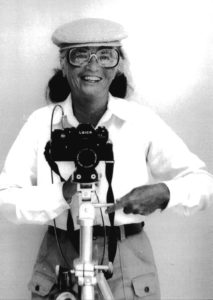
The artist Maggie Foskett died Dec. 1 in hospice care near her winter home in Sanibel, Fla., after a brief hospitalization, surrounded by her husband, son and daughter. She was 95.
Foskett, a summer resident of Camden, Maine, transformed bits of nature into brilliantly colored and spare, sometimes haunting shapes through a pioneering photographic technique known as cliché verre, the direct exposure of compositions onto photographic paper through an enlarger. She was among the first American artists to use cliché verre in photography and is credited with helping establish the technique as a photographic art form in the United States.
She exhibited at galleries and museums throughout the East Coast and her works are included in the permanent collections of the National Museum for Women in the Arts and the National Academy of Sciences in Washington, D.C., and in the Farnsworth Museum of Art in Rockland, Maine.
She had more than 25 one-women shows over her lifetime and in 2000, Foskett was included in “Photographing Maine 1840-2000,” a published compendium of Maine’s most significant photographers. In 2013, she was included in “Maine Women Pioneers III,” a collection of Maine’s best women artists.
“A sensitive and exacting observer, Maggie Foskett reveals nature’s incredible variety in new and surprising ways as she penetrates the internal structure of birds, plants, insects and reptiles,” a curator wrote of her 1998 exhibit at the National Academy of Sciences.
Born Margaret Edna Hughes in Sao Paulo, Brazil, on Nov. 15, 1919, Foskett was the first child of Edna and Reynold King Hughes, an American couple who relocated from the United States to South America for Hughes’ cattle ranching business.
Foskett completed her early education at the Sao Paulo Graded School, founded by her father, and matriculated to Bryn Mawr College in Pennsylvania in 1939, majoring in English.
Bryn Mawr College remained an important touchstone throughout her life, and she credited its faculty for instilling the belief that she could pursue her own interests at a time when women were expected to adopt traditional roles.
Foskett’s first marriage ended in divorce and she married her second husband, John D. Foskett, a Chicago businessman, in 1962, ultimately residing in the Chicago suburb of Geneva, Ill.
Foskett began her artistic career working with stained glass. At the age of 57, she enrolled in a community college course in photography and began shooting and developing black and white film.
But she became enthralled by the brilliant colors made possible by Cibachrome photography, and started working exclusively in color even though the medium had not yet been embraced by critics as a legitimate photographic art form alongside black and white photography.
At her second home on Sanibel Island, Foskett photographed tropical plants and sea shells, always at close range, and developed the images into 18 x 24 inch Cibachrome prints, magnifying small objects into larger than life works of art.
“A rag picker of small cosmologies in nature,” she sometimes called herself.
In 1984, Foskett moved from Illinois to Camden, Maine, and her career blossomed when she found a community of artists associated with Maine Photographic Workshops in the nearby town of Rockport.
Foskett studied photography with many of the best American photographers, including Ansel Adams, Sam Abell, Marie Cosindas, Ernst Haas and Jerry Uelsmann.
She discovered cliché verre by accident when, working in her darkroom in Florida, she turned on her enlarger and saw the translucent outline of a spider magnified on the photographic paper below.
She began experimenting with what she saw. She took tiny bits of plants and insects, created an arrangement between two glass slides, and exposed the slides through the enlarger directly onto photographic paper.
The resulting images revealed intricate details and variations of color unseen by the naked eye. The idea of unmasking the hidden beauty and mysteries of tiny pieces of nature fascinated her for the rest of her life.
In dragonfly wings, she found honeycombs. In plant stamen, she found snowfalls of pollen. In flower petals, she found rainbows of color.
She discovered that even rocks, cut thinly, could be shot through with the bright light of her enlarger to create extraterrestrial landscapes.
Through her many years of work, Foskett noticed the patterns of life’s building blocks repeated themselves in nearly every object she photographed. She remarked that she also came to understand the fragility of nature; some compositions of flowers or insects might fade so quickly she had time for only one or two images.
Foskett told one interviewer that her goal was to “show how delicate our balance with mortality is.”
She stopped using her camera completely in 1995, devoting all her energy to cliché verre prints made from her enlarger. In her most productive years, Foskett worked 10 to 12 hours a day in her darkroom, shredding images that failed to deliver their promise and sometimes emerging with only one good print for the day.
Late in her career, she became fascinated with x-rays of injured birds and animals, and composed images that superimposed natural objects onto the skeletal traces revealed on the x-rays.
She experimented with human x-rays, too, usually her own. One of her most memorable images shows blades of grass layered over an x-ray of her thigh, with the caption, “and then my bones will hold the seeds of summer grass.”
Foskett took one detour from cliché verre. In 2004, she created an exhibit out of a series of old black and white photographs she shot in 1979 at a shuttered institution for “wayward girls” in Geneva, Ill., dating to the late 19th century.
The photos included images of marked and unmarked graves on the grounds of the institution, known as the Illinois State Training School for Delinquent Girls, and the abandoned buildings that housed thousands of young women, many of whom died in childbirth while incarcerated.
The simple headstone of one 20-year-old girl, Sadie Cooksey, captivated Foskett and became the title of the resulting exhibition, “Who was Sadie Cooksey?”
She dedicated the show to “all the Sadies, past and present, who walk alone, sadly troubled.”
Physical limitations prevented Foskett from creating new artwork in the last decade of her life, but she found other interests to feed her creative mind and love of nature.
In Florida, she raised zebra longwing butterflies in her screened porch, tending the delicate chrysalises and delighting when the new life emerged. In Maine, she enjoyed feeding chipmunks from the palm of her hand on her back deck.
“She never really stopped,” said her husband, John Foskett.
Foskett remained an inspiration to dozens of artists and photographers, including her niece, the Vermont artist Sally Linder, and her stepdaughter, the Florida artist Lynn Foskett Pierson, and her unique body of work continued to be featured at galleries and museums. The Caldbeck Gallery in Rockland, Maine, represented the artist and her work.
Foskett’s last exhibition was at the Boston Children’s Museum in Boston in 2012-2013, and was titled, “For We Are All Sprung From Earth And Water.”
After cremation, Foskett’s ashes will be spread at her cemetery plot in Camden, Maine, at a time to be determined by her husband and children.
Foskett is survived by her husband, John Foskett; her daughter, Kate O’Neill; her son, Kenneth Hughes Foskett; her stepdaughter, Lynn Pierson; stepson, Chip Foskett; and five grandchildren: Liam W. Foskett, Robert W. Foskett, John Foskett III, Annie Mayers and Laura Pierson.
Foskett’s only sister, Dorothy Conklin, predeceased her in 2013.
In lieu of flowers, a charitable contribution in Foskett’s name may be made to: CROW, Clinic for the Rehabilitation of Wildlife, Sanibel, Fla., www.crowclinic.org/support-us/memorial-gifts.
41 E. 57th St., (212) 755-2828
Through March 1
Lois Dodd (b. 1927) has been painting compositionally idiosyncratic views of the architecture, vegetation, landscape and traces of human presence in rural Maine for six decades. During 2012-13, “Catching the Light,” an overdue museum retrospective of Ms. Dodd’s art, appeared at the Kemper Museum of Contemporary Art in Kansas City, Mo., and, appropriately enough, at the Portland Museum of Art in Maine. That the exhibition never made it to New York—where Ms. Dodd was the only woman among the founders of the important abstract expressionist venue, the Tanager Gallery; had her first solo show there in 1954; and bucked the tide by staying resolutely figurative—only adds to her status as a quiet heroine of stick-to-your-guns, painterly painting.
This show of almost 30 pictures, including a dozen portraits, as it were, of flowers, is Ms. Dodd’s first gallery outing since her retrospective. It’s honest, unflashy, done the hard way (Ms. Dodd’s thin oil paint on Masonite technique doesn’t permit second chances) and charming.
Her small renderings of a house in the snow, or the moon over a mud flat at 4 a.m., are masterly without preening as such. So it might seem picky and ungrateful to write so much as a word of mild doubt about an exhibition by this venerated plein-air painter. Sometimes, though, as when a vermilion shirt flutters too brightly on a clothesline that’s set against a delicately painted drab olive house and a green bush, or a flower is blown up to fit a format nearly 5 feet tall, Ms. Dodd reaches for obvious attention-getters. She’s had great shows. This is simply a good one.
—Mr. Plagens is an artist and a writer in New York.

Cicely Aikman Scherer died at Valley Cares in Townshend, Vermont, on December 6, 2013, eleven days after her husband Fred F. Scherer passed away. Born on June 4, 1923 in El Paso, TX, she was the oldest of three children of Duncan and Helen (Wyman) Aikman.
She attended the University of Chicago, but left in her sophomore year and went to New York City to study under Morris Kantor at the Art Students League, between 1942-1946. Aikman reflects; “This was a serious art education -our only regret as students was that due to World War II, we could not go to Europe, in particular to Paris to see firsthand the works of Picasso and Matisse.” At the League she met her first husband, painter Paul Breslin.
Cicely was an avid traveler. She went to Florence, Italy by boat with her two-year-old son, Paul Breslin Jr., and lived the bohemian life with her many friends. She lived in Peru from 1956-1957, traveling all over the region, Ecuador, Chile, Cuzco and Lima, Peru, where she taught English. Other trips included the Greek Isles and Turkey and countless journeys to France to visit her son Paul, who has made Paris his home.
Cicely worked as a librarian at the Hayden Planetarium of the American Museum of Natural History. There she met Fred Scherer, fellow artist, they married in 1969. In 1972 they moved to Friendship, where they lived there for 32 years and adopted and raised Fred’s grandchild, Kim Scherer. In 2005, Cicely moved to Brattleboro, Vermont with her husband to be nearer to daughter Deidre Scherer and her husband Steve Levine.
Cicely showed her work in galleries in New York City including The Artists’ Gallery, Green Mountain Gallery, Pyramid Gallery, and Westbeth Gallery. She painted winters in NYC and Vero Beach, FL, and summers in Provincetown and Maine. In 1972 she helped form a cooperative, the Waldoboro Gallery. Her work has been shown outside of NYC in numerous galleries and museums including the Maine Coast Artists, Round Top Center for the Arts, The Portland Museum, and The Farnsworth Museum. Since 2006, she has shown at the Brattleboro Museum & Art Center and Robert Crowell Gallery, Newfane, VT. From 1990 to the present, the Caldbeck Gallery in Rockland, ME has represented Cicely’s work.
Among her many interests, Cicely loved classical music, reading and writing poetry, literature and the writing of her memoirs. She also participated in numerous peace demonstrations during the 60’s and 70’s. Cicely will be remembered for her generosity, her love of animals, her liberal politics, and her poetic sense of form and color that made her such a unique and talented sculptor and painter.
Cicely is predeceased by first husband Paul Breslin; by second husband Fred F. Scherer and by brother Edward Aikman; she is survived by her sister Ann McQuade of Port Washington, NY; son Paul Breslin Jr. and his wife Catherine of Paris, France: daughter Kim Scherer and her husband, Paul Young of Seattle, WA; and four step-children; Janice-Ellen Scherer-Dufner and her husband, Frank Dufner, of Lyman, ME; William Scherer and his wife, Sitora, of Cold Spring, NY; Deidre Scherer and her husband, Steve Levine, of Williamsville, VT; and Gregory Scherer and his wife, Makhiruy, of Cold Spring, NY; 5 nieces and nephews; 14 grandchildren, and 8 great-grandchildren.
All are welcome to a memorial service that will be held on Sunday, December 15th, at 2:30 pm at Valley Cares, 461 Grafton Road, Townshend, VT, with a reception to follow.
The family expresses their heartfelt thanks to the amazing staff of Valley Cares for their professional, unending care and compassion; to Susan Nelson and her wonderful group of caregivers; the hospice staff of Bayada Services for their sensitive support and Dr. Timothy Shafer for his compassion and understanding.
Gifts may be made in Cicely’s name to Valley Cares, 461 Grafton Road, Townshend, VT 05353.
Fred F. Scherer
1915-2013
Fred Frank Scherer died at Valley Cares in Townshend, Vermont, on November 25, 2013, surrounded by family and friends. Born on March 1, 1915 in Queens, NY, he was eighth of nine children of William and Mary Ellen (Gerken) Scherer, and the last remaining of his siblings.
In 1930, while in an apprenticeship program of The School Art League of New York City, Fred was awarded their Saint Gaudens Medal for Fine Draughtsmanship and the Haney Medal for Fine Craftsmanship.
Fred spent the majority of his working life, 1934 through 1972, in the Exhibition Department of the American Museum of Natural History (AMNH). He learned the techniques of painting dioramas from his mentor, artist James Perry Wilson. Fred created and collaborated on numerous dioramas that are still on display at the AMNH, including fifteen that he personally painted in the Chapman Memorial Bird Hall, The African Hall and the North American Mammal Hall. Millions have seen his work and the dioramas are recognized worldwide.
“His passing ends an era for AMNH, as he was the last surviving background artist who made great contributions to the museum’s finest diorama halls and his work will stand for all time as a most significant contribution to the finest natural history diorama work in the world.” -Stephen Quinn
In 1967, Fred produced a Peruvian desert mural at the World’s Fair in New York. After retiring from the AMNH, Fred and his wife, artist, Cicely Aikman, lived for 32 years in Friendship, ME. He worked for twenty years as art consultant for the Maine State Museum in Augusta, ME, where he also painted dioramas.
A tireless and energetic spirit, he turned his attention to other pursuits including designing and building the family home. An intrepid inventor, he made an endless stream of practical devices, some specializing in successfully deterring squirrels from bird feeders. An early supporter of the “modern organic gardening movement,” he cultivated blueberry bushes and loved harvesting vegetables from his and Cicely’s large garden. While in Maine, he enjoyed going out to fish the waters in and around Friendship Harbor with his lobstermen friends.
Growing up in a house filled with music, Fred loved music of all types and was a wonderful self-taught pianist who played by ear. He continued to paint and draw up to his final days. Fred Scherer attended the Advent Christian Church of Friendship, ME, for many years, and more recently, the Calvary Chapel in West Townshend, VT. Fred is survived by his second wife of 44 years, Cicely Aikman Scherer, of Valley Cares, Townshend, VT; and by his four children with his first wife, Marguerite Scherer, deceased: Janice-Ellen Scherer-Dufner and her husband, Frank Dufner, of Lyman, ME; William Scherer and his wife, Sitora, of Cold Spring, NY; Deidre Scherer and her husband, Steve Levine, of Williamsville, VT; and Gregory Scherer and his wife, Makhiruy, of Cold Spring, NY; adopted daughter, Kim Scherer and her husband, Paul Young, of Seattle, WA; and stepson, Paul Breslin and his wife, Catherine, of Paris, France; 14 grandchildren, 8 great-grandchildren and a large extended family. Fred made many friends during his life who will all miss him.
All are welcome to memorial services that will be held on Wednesday, December 4th, at 3 pm at Valley Cares, 461 Grafton Road, Townshend, VT; and on Sunday, December 8th, at 2 pm at the Calvary Chapel, Route 30, West Townshend, VT. Receptions will follow both events.
The family expresses their heartfelt thanks to Dr. Tim Shafer; to the amazing staff of Valley Cares for their professional, unending care and compassion that they gave to Fred and continue to give to Cicely; and to Susan Nelson and her wonderful group of caregivers, as well as the hospice staff of Bayada Services for their sensitive support.
Donations can be made in Fred’s name to Valley Cares, 461 Grafton Road, Townshend, VT 05353; or to the Calvary Chapel, Rte 30, West Townshend, VT 05359.
by Daniel Kany
John Goodman’s photographic prints are incomparably luscious. The idea of an aesthetic texture such as Goodman’s exquisitely soupy grains is like brushwork. In some artist’s hands — say, Van Gogh or Monet — style begins with the smallest bits in their pictures — the brush strokes — as opposed to artists like Andrew Wyeth whose critical textures are tied to the overal picture’s high focus.
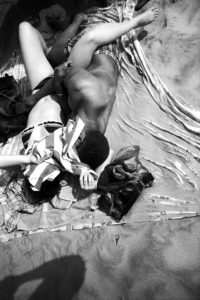
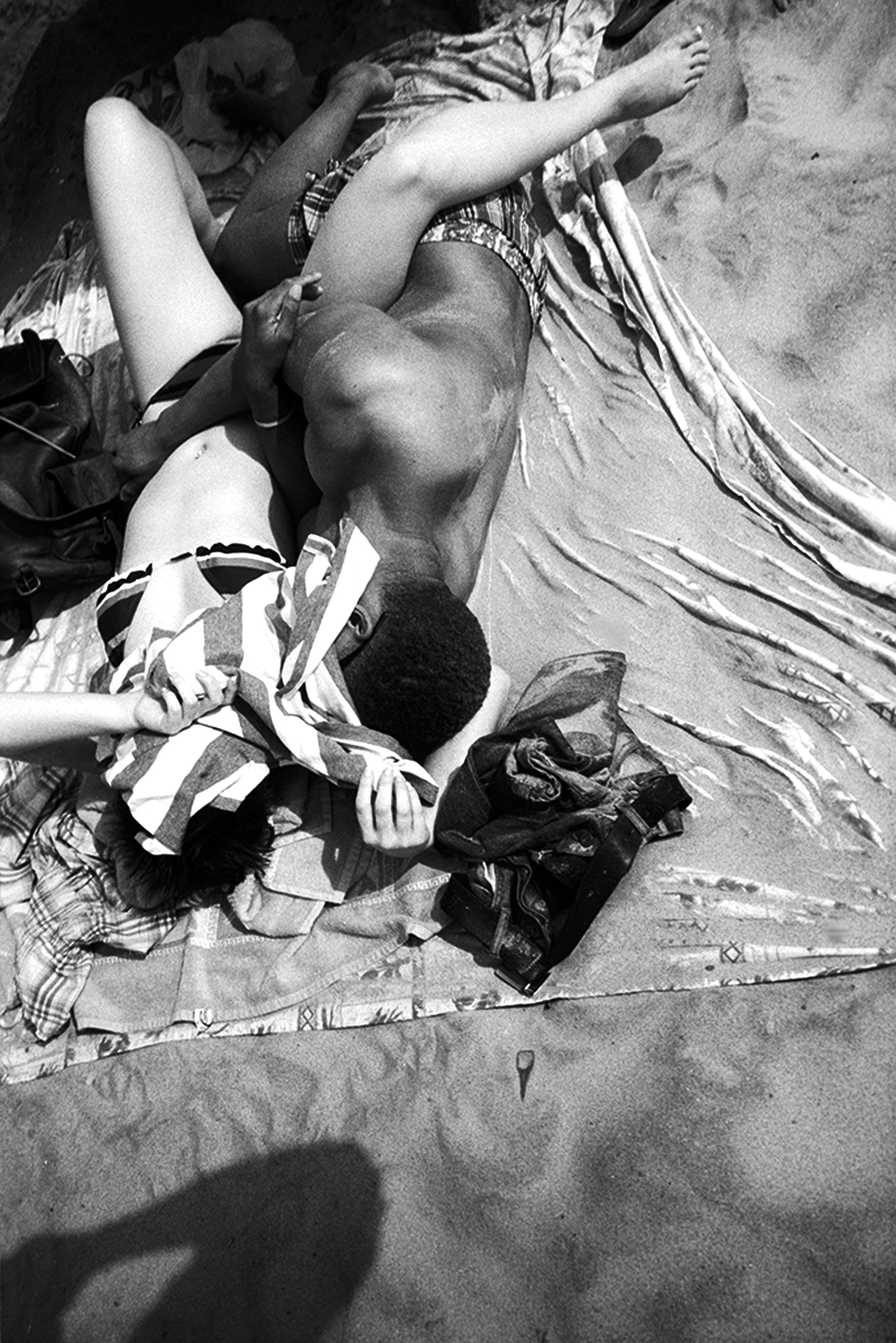
In his 2007 silver print “Father’s Day/Coney Island,” Goodman present a young couple sprawled in a chaotically suggestive pose on a beach blanket, angled off with their feet away from the viewer. A bikini-clad young woman is on her back, passive but sexually spalyed as her man lies on his side actively engaged as a paramour in hot pursuit. Their faces are covered with a towel for a bit of ostrich-like privacy — which feels fully invaded by the seemingly stolen snapshot evidenced by the crooked-elbow shadow of the picture-taker.
But something is wrong. The ostensibly-in-the-heat-of-the-moment couple’s beach blanket is covered by long-blown sand. Its wrinkles belie a wizened artifact more than ephemeral passion. And the beach is the hard-tack, black-sealed, creement-solid surface of fine-sand low-tide. It’s the grain of sand and photo. It’s a young woman’s white knee pressing into the rich black upper left corner of the print.
This is no snatched kiss. It’s an extraordinarily complex and well-composed photograph shot with the final print in mind. It is the soft white of her body against his chiseled dark form, the shape of the lovers’ form on the sand, and the cacophony of textures and values that Goodman orchestrates into a symphony of formal brilliance. It’s about relative time — as is all of “Black White + Blue.
“
This is the subject of the high-focus “Emma Mahler,” an old lady standing in a weathered garage with a 1930’s car. Here Goodman plays the idea of age against something dated. The car is old-fashioned, but the woman — the undoubtedly sparky — is aged. We see ephemeral fasion in the design of the car and in her patterned dress and heels. The plants of the garage are past their prime and the way they block it reveals the car is a relic as well. All this forces us to check the date of the photo — 1974 — and recast Emma and her accoutrements against the age of the print. It’s an exciting process until you realize what 40-years-later means for Emma. And then we see that Goodman isn’t just clever, but profound.
At his best, Goodman’s gorgeously grainy images play solidity and motion against each other. In his “Dominoes/Havana,” we see two hands flying over a set of dominoes to mix them up. With increased motion, there is more blur – the lively vehicle of graininess. So the textures of the hands and closest dominoes stand in contrast to the sculpturally solid volumes of the untouched pieces in the middle. The table, too, plays this game since the paint has been worn away closest to the players’ hands. This is Goodman’s complete human-touch metaphor: We see the grain and the wear at the edges of human touch — in the objects as well as the photographs.
A particularly masterful print is Goodman’s 1993 “Summer Shower/Tuscany” in which a man and horse shower after a ride. The man stands arch-backed and shirtless (and with his solid lower body in dark pants, satyr-like) under an outdoor shower while holding a hose on his equine companion. Because the strong sun is behind the shower-supporting building on the far left, the drops and spray are in white sparkling high-relief everywhere against the contrasty-dark and silhouetted landscape below the light-burned sky. We feel the textures of the dazzling water: drops on the satyr-man and spray on the horse, as though shaking itself dry from a bath.
This is so much more than seeing and grabbing a picturesque moment with a camera. This print is a reminder that photography is a complete art when the person behind the lens is also a master printer.
The other part of “Black White + Blue” is a set of color images from slides shot in the 1970’s and 80’s and printed for the first time in 2010. This technological disconnet is fascinating — since “archival pigment prints” (a digital process) didn’t exist when the slides were shot. Once again, however, Goodman employs these as a master of time. He shows us a red-soaked cinema in 1985 with a cigarette machine that would have us date it years before. A mannequin (or isit?) stands away from us nude but for a square of butcher paper taped to the window — so contemporary but for the outdated “Bank Americard” placard. In “Woman Driver, South Boston,” we see a woman in curlers driving a car that, on closer inspection, has seen better days; the car inspires us to think harder about the makeup she’s wearing: Is it there to make her prettier or to cover her nicks and dings?
“Black White + Blue” is a rich story of Maine photography. At the Maine Media Workshops + College, Goodman (a student of major photographer Minor White) was an instructor of photographer/Pho Pa co-owner John Edwards. But following a 2012 exhibition at the Metropolitan Museum of Art, it’s clear Goodman is also a player in the national photography conversation. Moreoever, Goodman’s prices — $3,000 for a print — raise questions we don’t have time to visit here, such as: Is the reason we don’t have a functional photography market in Maine because of the disconnet with NYC bubble-market pricing?
Maine is soaked in great photography: not only through the MMW+C but Colby, Bowdoin, Bates, PMA and artists throughout the state. This is the land not only of Berenice Abbott but Paul Caponigro and William Wegman, after all. But the Maine photographic community has yet to connect with a local market. Photography is here now; it just needs standards, leadership and time to find purchase in the market. In a season when I have been writing about nothing more than photography, Goodman’s “Black White + Blue” is a high water mark.